 StarMaker: Sing Karaoke Songs
Why StarMaker Turns Karaoke Into a Social Music Habit
StarMaker is more than a karaoke library: it is a carefully engineered social loop where music discovery, performance, identity, and platform reach reinforce one another.
StarMaker: Sing Karaoke Songs looks like a karaoke app, but that description undersells what is happening on the screen. After spending time with it, I came away seeing a more ambitious product: a social music platform that uses singing as its entry point and turns every performance into a piece of user-generated distribution. The song is the bait, the recording is the content, and the reaction loop is the retention engine.
That distinction matters. A conventional music player wants you to listen for as long as possible. StarMaker wants you to listen, choose a song, perform it, edit the result, publish it, watch someone else respond, and return with a slightly stronger sense of identity. Its power is not based on owning the entire music ecosystem. It comes from organizing participation around familiar songs and making the phone feel like a private studio, a stage, and a social feed at once.
StarMaker is a platform strategy disguised as karaoke
The big-picture thesis is simple: StarMaker turns passive music consumption into a repeatable social behavior. That shift gives the app a different kind of leverage from YouTube Music, Samsung Music, or Shazam: Find Music & Concerts. Those products help users identify, play, or discover music. StarMaker asks users to become part of the music surface themselves.

See More Apps by StarMaker: Sing Karaoke Songs


That is a meaningful change in mobile behavior. Listening is easy to do in the background, but singing requires a decision. You pick a track, select a vocal arrangement, adjust your headphones, and decide whether the result is good enough to share. StarMaker reduces the friction around each step. Its catalog presents recognizable songs, its recording tools make the process approachable, and its social layer gives the performance somewhere to go.
The app does not need every user to be a serious singer. In fact, its design works because it welcomes people who are curious, nervous, playful, or simply looking for a few minutes of entertainment. The promise is not that everyone will sound professional. The promise is that anyone can enter the performance loop.
The company power behind the app
StarMaker’s company-level advantage is not the same as the power held by a giant operating-system owner or a global video platform. Its strength is specialization. The product has been shaped around a narrow but fertile behavior: people want to sing along with popular songs, hear themselves improve, and receive recognition from other listeners.
That focus lets StarMaker make decisions that a general-purpose music service may avoid. The interface can prioritize vocal effects, duet invitations, performance feeds, challenges, and creator identity without pretending that karaoke is merely another playback mode. The app is not trying to be a neutral shelf for albums. It is building a culture around amateur performance.
There is also a less visible form of company power in the licensing and moderation work required to make this possible. A karaoke catalog depends on rights, lyric synchronization, regional availability, and rules around user recordings. The user sees a song list and a record button; behind that is a supply chain that determines which songs can become social prompts. Every unavailable track is a small break in the fantasy that the phone contains an endless stage.
StarMaker’s business position therefore depends on balancing three groups: rights holders, users who create performances, and audiences who consume them. If the catalog is weak, performers leave. If the social feed is empty, creators lose motivation. If monetization becomes too aggressive, casual singers may feel that the app is charging admission to a hobby.
How StarMaker fits the wider mobile ecosystem
StarMaker sits between several familiar categories. It borrows the catalog logic of a music service, the camera-and-editing behavior of a short-video platform, and the feedback mechanics of a social network. It also competes for the same small moments that Lark Player:Music Player & MP3 and other lightweight audio apps occupy: the commute, the bedroom, the kitchen, the pause before sleep.
Yet StarMaker does not primarily win by being the best place to hear a finished track. YouTube Music is stronger as an enormous listening and video-discovery destination. Samsung Music can feel more direct for users who simply want local playback and library control. Shazam remains excellent at answering the question, “What song is this?” StarMaker answers a different question: “What would it feel like if I performed this song and someone heard me?”
That positioning gives the app a distinct role in the ecosystem. It is not only a destination; it is a conversion layer. A song discovered elsewhere can become a performance inside StarMaker. A performance created in StarMaker can send people back toward the song, the artist, or another creator. The app turns music recognition and listening into participation.
On a phone, that conversion is especially powerful because the hardware already contains the necessary pieces. The microphone captures the voice, the screen displays lyrics and visual feedback, headphones provide monitoring, and the camera can add a face or a performance setting. No dedicated karaoke machine is required. The smartphone has absorbed the room once occupied by a television, microphone, speakers, and a stack of discs.
Distribution is the first major advantage
StarMaker benefits from distribution leverage that older karaoke products never had. A physical karaoke system depended on a location and a fixed collection of songs. A mobile app can travel with the user, update its catalog, surface trends, and place performances in front of people who were not present when they were recorded.
This matters because social products become more valuable when their content can move. A good performance is not trapped in the original session. It can appear in a feed, attract comments, inspire a duet, or encourage another singer to attempt the same song. The app turns one recording into a possible chain of interactions.
Distribution also changes the emotional stakes. In a living room, a weak performance disappears when the song ends. In a social app, it can remain visible, searchable, and comparable. That permanence can motivate users to improve, but it can also make the activity feel less spontaneous. StarMaker has to keep the atmosphere casual enough that people will risk sounding imperfect while still making the results attractive enough to watch.
The phone’s notification layer adds another advantage. A new comment, invitation, or reaction can pull a user back into the app without a planned listening session. This is a familiar platform tactic, but StarMaker gives it a particularly personal form: someone is not merely reacting to a post; they may be reacting to your voice.
The habit-forming decisions are carefully chosen
StarMaker’s retention loop begins with recognition. Familiar songs lower the barrier to entry because the user already knows the melody, mood, or emotional story. From there, the app offers a sequence of manageable decisions: sing alone, join another performance, choose a vocal effect, add a visual treatment, save the take, or publish it.
Each decision creates a small investment. By the time the recording is finished, the user has done more than press play. They have selected a song that says something about them, made a performance, and edited the way they want to be perceived. That personal investment makes feedback more valuable than an ordinary playlist recommendation.
The duet format is particularly effective. It changes singing from a solo test into a shared activity, even when the two people record at different times. The user is not facing an empty microphone; they are answering another voice. That structure makes the app feel less intimidating and gives the social graph a musical shape.
Effects and vocal tools serve a similar purpose. They are not only technical utilities. They help users cross the psychological gap between “I am singing into my phone” and “I am making a performance.” A little reverb, pitch assistance, or visual polish can make an amateur recording feel intentional. Used well, these tools encourage participation without completely hiding the human voice.
The risk is that the loop can become repetitive. Browse, sing, edit, publish, react, repeat is effective, but it is still a loop. Users who do not care about public feedback may run out of reasons to return, while users who do care may find themselves chasing approval rather than enjoying music.
What this means on phones
StarMaker shows how the smartphone has changed the meaning of a music app. A phone is no longer just a speaker or a remote control for a larger library. It is a personal media studio with an audience attached. The same device that plays a finished recording can capture an unfinished voice and package it for public attention.
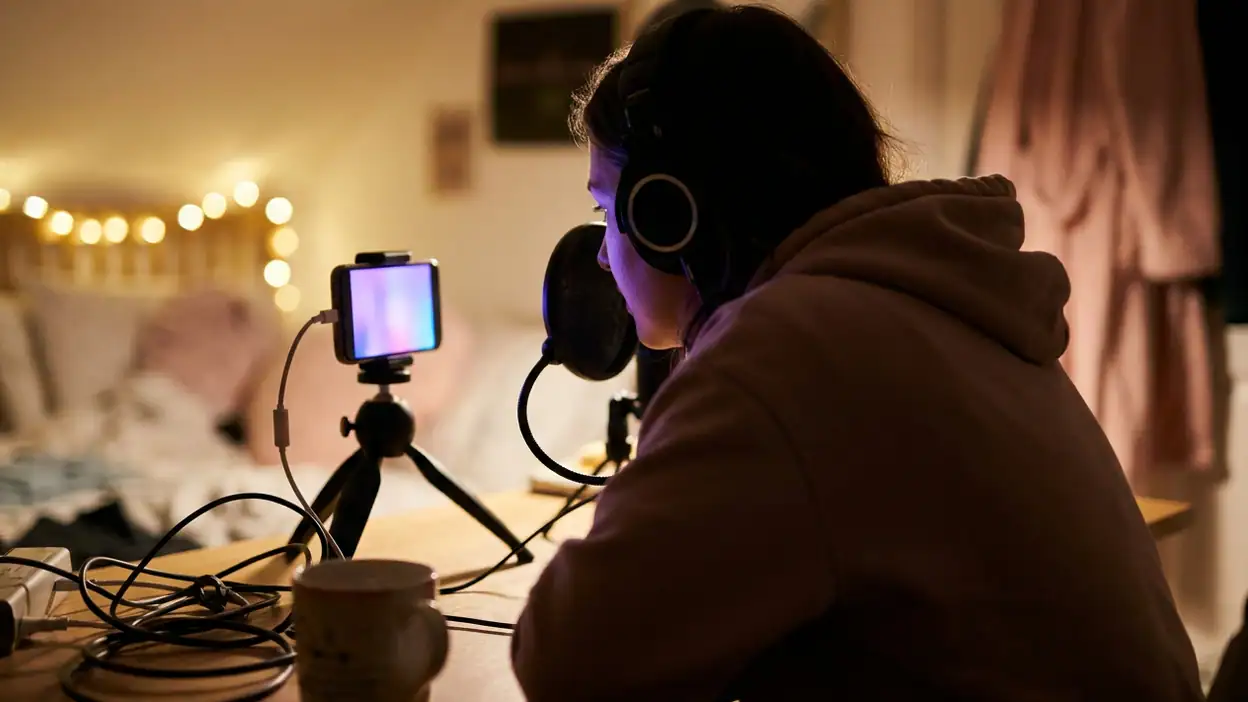
That makes the app unusually dependent on intimate spaces. People sing in bedrooms, parked cars, kitchens, and quiet corners where they can control embarrassment and acoustics. The best StarMaker session may not look impressive from the outside. It may be one person wearing wired or wireless headphones, holding the phone at a careful angle, and repeating one line until the timing feels right.
This intimacy is one of the product’s strongest qualities. The app makes music creation available without requiring a stage, a band, or formal training. It can give a shy user a low-risk way to experiment with performance. It can also connect people across language, geography, and age through songs that carry emotional meaning even when conversation would be difficult.
But the phone also compresses several roles into one device. It is the instrument, recorder, editor, publisher, audience, and marketplace. That concentration is convenient, yet it means StarMaker competes with every other demand on the same screen. A notification from a work app or a message from a friend can interrupt the performance loop instantly.
Audio quality is another practical limit. Results depend on microphone placement, room noise, headphones, network conditions, and the user’s willingness to learn the controls. StarMaker can make singing approachable, but it cannot make a noisy room quiet or turn every phone microphone into studio equipment. The app’s polish raises expectations that the hardware cannot always meet.
How rivals respond to this kind of power
Rivals do not need to copy StarMaker feature for feature to challenge it. YouTube Music can use its enormous music and video ecosystem to make listening more interactive. It already has the distribution needed to expose users to performances, live clips, and fan communities. Its advantage is reach, while StarMaker’s advantage is a tighter focus on the act of singing.
Samsung Music represents a different kind of contrast. A straightforward player can win by staying out of the way, especially for users who own local files and want reliable playback. That simplicity highlights StarMaker’s trade-off: the karaoke app asks for more attention because it is trying to create a social activity, not just deliver audio.
Shazam approaches music from the moment of discovery. It identifies a song and points the user toward listening options, concerts, or artist information. StarMaker takes the identified song and turns it into a possible performance. If these products are connected through links, recommendations, or shared cultural moments, each can feed the others. If they compete for attention, StarMaker must persuade users that making music is more rewarding than merely finding it.
Lark Player and similar audio players can also compete through speed and low friction. They may be better for users who want music immediately, with fewer accounts, feeds, or creative decisions. StarMaker’s answer is that effort can be the product. The extra steps are not obstacles if the user wants recognition, collaboration, or a sense of progress.
Where users benefit
Users benefit most from the way StarMaker lowers the cost of participation. You do not need to book a studio, buy specialist equipment, or persuade a group of friends to sing at the same time. The app gives you a catalog, a guide track, recording controls, and a potential audience in one place.
That accessibility has cultural value. Karaoke has always been social, but mobile karaoke can reach people who would never enter a public karaoke bar. The user controls the timing and exposure. They can record privately, publish selectively, or participate through a duet that feels less vulnerable than a solo performance.
The feedback system can also create a useful sense of progress. Hearing an old recording beside a newer one makes improvement tangible. Even small gains in timing, confidence, or breath control become visible because the app preserves the performance history. For some users, this is a casual creative outlet; for others, it becomes an informal training routine.
Discovery benefits too. A performance feed can lead users to songs, artists, and styles they would not have searched for directly. Because the recommendation comes through a person rather than a generic category, it may carry more emotional weight. The singer becomes part of the recommendation.
Where users lose leverage
The same system that gives users a stage also turns their attention and performances into platform assets. Every recording can increase the app’s content supply, keep other users engaged, and strengthen the value of the network. Users receive tools and visibility, but the platform receives a growing library of activity that it can organize and monetize.
That imbalance deserves attention. A creator may spend time refining a performance without having much control over how it is recommended, who sees it, or how long it remains valuable. Visibility is governed by product decisions that can change without warning. A feed that rewards frequent posting may encourage quantity over enjoyment, while paid features can create a gap between casual participants and users willing to spend more.
There is also a privacy cost in turning voice and image into social identity. Even when a user intends to share casually, a recording can reveal personality, location clues, relationships, or habits. The more the app encourages public performance, the more important its controls around visibility, deletion, moderation, and data handling become.
Licensing and catalog decisions can limit user agency as well. A favorite song may disappear, become unavailable in a region, or change format because of rights arrangements. Users build memories around performances, but the underlying availability belongs to a larger commercial system. The phone feels personal; the catalog is not.
Finally, the app can subtly redefine success. Singing for fun is one goal. Receiving reactions, gaining followers, and appearing in prominent feeds are different goals. StarMaker’s design makes the second set of goals easy to notice, which may cause users to judge their own voices through metrics rather than pleasure.
The strategic lesson
StarMaker demonstrates that platform power does not always begin with a giant catalog or an operating system. It can begin with a well-chosen behavior that people repeat willingly. Singing is emotionally charged, technically simple enough to attempt, and naturally suited to sharing. That combination gives the app a strong foundation for ecosystem growth.
The company’s challenge is to preserve the feeling of play while operating a serious platform. If monetization, ranking, or promotional pressure becomes too visible, the app risks turning an inviting hobby into a performance marketplace. If the social layer becomes too shallow, the catalog and recording tools may not be enough to keep users returning.
For the wider mobile industry, the lesson is clear. The most valuable apps increasingly sit between categories. They do not merely stream, edit, communicate, or recommend. They connect those actions into a loop that changes what users do with their phones. StarMaker makes a music library more active, a camera more expressive, and a social feed more personal.
My final verdict is favorable, with an important qualification. StarMaker is compelling because it understands that karaoke is not really about reproducing a song perfectly. It is about taking a familiar song and making it yours for a few minutes. The app’s best decisions support that impulse with approachable tools, a broad social stage, and enough creative control to make a rough take feel worth sharing.
Its weaknesses are inseparable from its strategy. The feed can encourage approval-seeking, the catalog depends on forces users cannot control, and the platform benefits from participation at least as much as participants do. Still, as a piece of mobile product design, StarMaker is sharper than a simple karaoke utility. It is a distribution machine built around human expression, and that is why it deserves to be understood as a platform rather than just another music app.
You May Also Like

 AccuWeather: Weather Radar
AccuWeather Review: A Quick, Clear Forecast for Everyday Decisions
For everyday plans, the best forecast is the one you can understand quickly. AccuWeather makes rain timing, radar, and local conditions easy to act on, with a few trade-offs.

 Hill Climb Racing
Why Hill Climb Racing Still Turns Crashes Into One More Run
A tiny car, a bumpy hill and one more upgrade: Hill Climb Racing keeps resurfacing because its simple chaos makes every near-miss feel personal.

 AliExpress - Shopping App
AliExpress Makes Global Shopping Feel Personal, but Shoppers Bear the Risk
AliExpress turns a global marketplace into a pocket-sized discovery engine. Its reach is useful, its shopping loop compelling, and its trade-offs easy to miss.

 Lords Mobile: Kingdom Wars
Lords Mobile Is a Kingdom-Building Routine, Not a Quick Match
A case-by-case verdict on the building, battles, device demands, and social commitments that make Lords Mobile rewarding for some players and exhausting for others.

 PDF Scanner app - TapScanner
TapScanner Makes Paperwork Easier to Capture, Check, and Share
TapScanner makes scanning with a phone feel less like a rescue operation and more like a dependable step in getting work done. Its capture tools are useful, though not flawless.

 Block Blast!
 Shows How Much a Puzzle Game Can Leave Out
A quiet grid game shows why puzzle players increasingly value instant clarity, repeatable skill and low-pressure play—and where the genre still needs to catch up.