 Block Blast!
 Shows How Much a Puzzle Game Can Leave Out
A quiet grid game shows why puzzle players increasingly value instant clarity, repeatable skill and low-pressure play—and where the genre still needs to catch up.
The most revealing thing about Block Blast! is not that it makes a familiar puzzle feel new. It is that it makes the familiar parts feel almost sufficient. There is no mansion to rebuild, no cast of characters waiting for another chapter, and no elaborate obstacle course to learn. You place blocks, clear lines and try not to run out of room. That stripped-back loop is a useful measure of where mobile puzzle games are now: players still want the snap of a clean solve, but they are increasingly willing to leave behind the reward ladders and narrative scaffolding that once made every session feel like a campaign.
That does not make Block Blast! a blueprint for every puzzle game. Its board-based survival loop has its own limits, and the match-three games that surround it serve different appetites. But it puts pressure on a category accustomed to adding more: more levels, more currencies, more events, more reasons to return. The game’s strongest argument is that a puzzle can earn repeat play through a readable decision and a satisfying consequence, not only through a stream of unlocks. The category’s next standard may be less about how much a game contains than how quickly its central pleasure becomes clear.
The puzzle baseline has changed
Mobile puzzle games have spent years refining a recognizable contract. A player should be able to understand the immediate task at a glance, make a move with one finger, and receive clear feedback when something goes right. The board must be legible on a small screen. A session should fit into spare minutes, while the game should provide enough progression to make those minutes feel connected. These are no longer distinguishing features; they are table stakes.

See More Apps by Block Blast!


The category has also taught players to expect a second layer around the puzzle itself. In games such as Fishdom and Matchington Mansion, matching is part of a larger structure: levels feed decoration, characters, collections or story beats. Toy Blast and Toon Blast make the level map and episodic progression central, turning each cleared board into one step along a visible route. Royal Match adds a polished stream of rewards and themed activities around its match-three challenges. The exact mix varies, but the basic promise is familiar: solve a board, receive something, and see what the next solve will unlock.
That framework works because it supplies direction. A level has a goal; a reward gives it a consequence; a map or renovation project makes progress visible. It also supports long-term play by giving players more than the puzzle to care about. But the same structure can make a game feel like a checklist with a board attached. When progression systems crowd the screen or a player’s attention is split between the immediate challenge and several distant tasks, the puzzle can become a means to collect rather than the reason to play.
Players now arrive with sharper expectations. They want fast onboarding, but they also want enough room to improve. They want a game that respects a short break, without making every session feel disposable. They are familiar with event calendars, currencies and reward tracks, so those systems no longer impress simply by existing. A new game has to show why its decisions are interesting before asking players to care about the next reward.
A board that makes the decision the reward
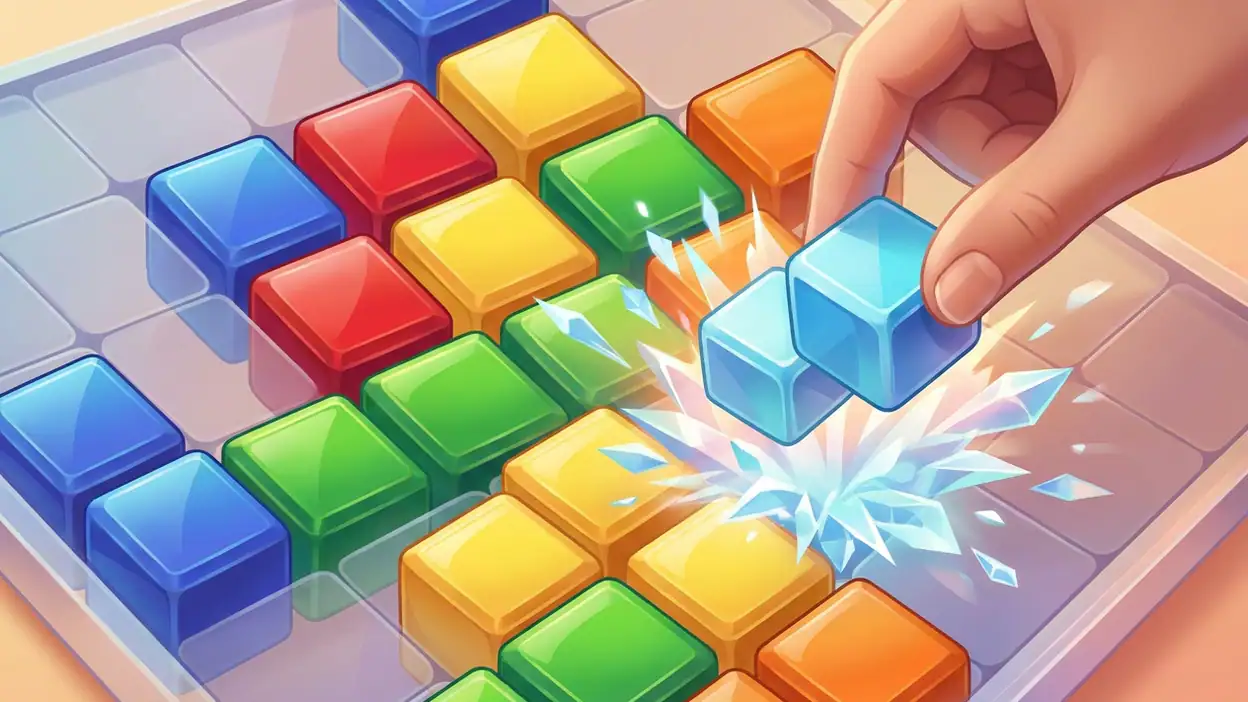
Block Blast! is built around a simple rhythm. A small set of block shapes waits beside a square grid. The player places them one at a time, filling rows or columns to clear space and keep the board alive. The shapes are not rotated to fit, and the board does not send pieces falling through gravity after a clear. Each placement is a commitment: use a good opening now, or preserve room for a piece that may be harder to accommodate later.
That creates a distinctive tension. A line clear feels immediate and tidy, but it also changes the geometry of the board. Open space is useful only if it stays usable; a wide pocket can be less valuable than several flexible gaps, depending on what pieces arrive. Since the next set is visible, the player is not guessing blindly. The challenge is to judge how those pieces will fit together and how much room the board needs to retain for what comes after.
The strongest signal here is clarity without emptiness. The rules take moments to grasp, but the decisions keep accumulating. A novice can place blocks confidently before understanding how quickly a board can become awkward. An experienced player starts to see the grid as a set of future options: where a long piece might go, which line can be completed efficiently, and whether clearing now is worth leaving an uncomfortable gap. The game does not need a tutorial full of exceptions to make the next move meaningful.
Its visual feedback supports that compact loop. Blocks sit cleanly in the grid; completed lines disappear with a direct, readable payoff. The board is the whole stage, so there is little visual noise competing with the consequences of a placement. That restraint matters on a phone. A player can glance down, assess the layout, make a move and look up again without having to reacquaint themselves with a story scene or a layered menu.
The rhythm is gentler than a timer-driven arcade puzzle but more demanding than a purely casual pastime. There is no need to race a countdown, yet the board gradually tightens until every placement feels consequential. A good run has a pleasant cadence: spot a line, fit a piece, regain room, then find the next useful arrangement. A poor decision can linger for several turns, a reminder that the game’s pressure comes from spatial scarcity rather than speed.
Familiar pleasures, different priorities
Block Blast! follows several conventions that mobile players already understand. Its controls are direct, its board communicates the task without explanation, and each move produces visible feedback. It offers the comfort of a puzzle that can be started and stopped without ceremony. Those are not radical ideas; they are part of the established mobile design language. The difference is what the game declines to put around them.
In many leading puzzle games, progress extends beyond the board. Matchington Mansion can turn cleared levels into a continuing renovation; Fishdom gives matching a setting populated by aquarium life; Toy Blast and Toon Blast make a sequence of stages and their themed presentation a substantial part of the draw. Royal Match similarly combines match-three play with a broader progression framework. Those layers give players goals that survive the end of an individual level. They can also make the overall experience feel generous, because every win appears to move several things forward.
Block Blast! challenges the assumption that a puzzle needs a destination outside itself. Its most meaningful progress is local: the board remains manageable, a tight sequence opens up, or a personal run lasts longer than expected. The payoff is less like finishing a chapter and more like solving a problem under changing conditions. That makes replay less dependent on a map full of unopened stages. The question is not only, “What do I unlock next?” It is also, “Can I read this board better than I did last time?”
There is a cultural shift inside that choice. Many mobile games now compete for sustained attention with daily tasks, limited-time events and layered progression. Block Blast! makes a case for play that does not need to justify itself through a growing pile of content. It can be engaging because the board keeps presenting a fresh arrangement, not because a new character or renovation task has appeared. That is a meaningful contrast, though not a universal improvement. Players who enjoy an unfolding world may find the game’s narrow focus less emotionally sticky.
Its simplicity also makes its weaknesses easy to see. A board-based loop can become repetitive, particularly when a player wants a sense of discovery that goes beyond arranging familiar shapes. The game’s run-based pressure can create a strong “one more try” impulse, but a high score is not the same as a broad progression arc. For some players, the lack of a substantial setting or evolving objective will feel refreshing; for others, it may leave little to anticipate between sessions.
What its peers reveal
The related games clarify why the category should not simply copy Block Blast!’s minimalism. Fishdom’s aquarium theme gives the matching loop a visible place to return to, while Matchington Mansion ties play to a renovation fantasy and a continuing stream of tasks. Toy Blast and Toon Blast make their level sequences easy to follow, with familiar goals and a sense of forward movement. Royal Match demonstrates how a polished presentation and a steady rhythm of rewards can make a conventional match-three structure feel expansive. These games rely on more than one kind of motivation, and that is precisely their strength.
They also reveal a design cost. Every layer needs attention: a player must understand the puzzle, interpret the reward, track the event, and sometimes decide which longer-term objective matters. Strong presentation can make that complexity feel inviting, but more systems do not automatically make the core move more interesting. If the board is merely a toll booth on the way to decorations or prizes, its own design has less room to carry the experience.
Block Blast! provides a counterexample rather than a replacement. It concentrates attention on one decision loop and lets replay emerge from variation in the board. The trade is clear. It gives up the character arcs, collectible scenery and chapter-by-chapter momentum that make games like Matchington Mansion or Royal Match easy to invest in over time. In return, it lowers the number of things a player must remember and makes the value of each move more immediate.
That contrast points to a more useful standard for the genre: layers should deepen the game’s central pleasure, not compensate for its absence. A progression system can give a puzzle context, but it should not be the only reason to complete another level. An event can add a fresh constraint or goal, rather than merely placing another timer over familiar play. And a stripped-down game should offer enough strategic variation that simplicity does not collapse into sameness.
This is where Block Blast! is most instructive. The board’s openness is not just a visual style; it is a commitment to letting players see the problem. There is no hidden narrative payoff to distract from an awkward placement. The game asks the player to take responsibility for the shape of the board, then offers another run as a chance to make a better choice. That is a clean form of agency, even if it cannot provide the broader sense of ownership that comes from building a town, decorating a room or growing a collection.
The standard taking shape
The emerging standard is not “make every puzzle game minimal.” It is “make the main pleasure legible, then earn every added layer.” Players should be able to understand what a game asks of them almost immediately. Once they do, the game should reward attention rather than merely input. Block Blast! meets that test through spatial judgment: the interface is simple, but the player’s choices shape the difficulty several turns ahead.
For more elaborate games, the same standard means progression needs a clear relationship to the play. A level map is useful if it creates a satisfying sense of advancement. A decorating project has value if it makes wins feel connected to a world the player wants to shape. Events earn their place when they change the rhythm or offer a genuinely different objective, not when they repeat the same loop with a new badge. The category is moving toward a more demanding question than “How many rewards can we add?” It is asking whether each reward supports the reason the player came.
Replay value is part of that shift. In Block Blast!, the return is built from an unfinished strategic itch: a board nearly worked, a line was left open, or a run ended after one move too many. The pleasure is measurable but personal. Another player’s score does not change the grid in front of you; the useful comparison is with your own judgment. That makes replay feel self-directed, a quality that can be harder to sustain than a reward schedule but more satisfying for players who enjoy mastery.
Still, the category has not solved the problem of attention. A low-friction puzzle can be easy to reopen precisely because it asks so little of the player. That convenience is part of its appeal, but it can also blur the line between a chosen break and automatic checking. More expansive games use events and notifications to maintain momentum; a minimalist game may rely on a repeatable loop that asks for “one more run.” Neither approach is automatically respectful. The measure should be whether a player feels in control of the session, not simply whether the game can bring them back.
Block Blast! also leaves room for stronger variation. Its core rules are clear and sturdy, but a longer-term puzzle experience can benefit from goals that alter how players read a familiar board. Carefully designed challenges, optional constraints or meaningful modes could widen the experience without burying the grid under menus. The risk is obvious: add too much and the game loses the very directness that gives it force. The opportunity is to add depth in ways that change decisions, not just the reward wrapper.
That tension is the category’s broader lag. Mobile puzzle games have become skilled at extending the lifecycle of a successful loop, but extension is not the same as evolution. A new event can refresh the calendar without changing play. A new decoration can make progress visible without making the puzzle more interesting. Meanwhile, a focused game can offer a crisp experience but struggle to give a devoted player a reason to feel that the world is growing. The next step is not to choose between a pure puzzle and a content-rich game. It is to connect long-term structure to genuine new ways of thinking.
For players, this shift means there is no single ideal format. Someone looking for a compact, repeatable mental break may prefer Block Blast!’s open board and immediate stakes. Someone who wants a continuing setting, collection or chain of level goals may get more from Fishdom, Toy Blast, Toon Blast, Matchington Mansion or Royal Match. The useful change is that these preferences are becoming easier to name. A game can be judged not only by how polished it is, but by whether its extra systems suit the kind of attention it asks for.
Block Blast! makes its case in the few seconds between seeing three available pieces and committing the first one. That small pause contains the whole appeal: a clear rule, several plausible choices, and the knowledge that the board will remember what you do. Its limits are just as clear. It does not offer the breadth or narrative continuity of a layered puzzle world, and a repeating board can lose its pull for players who need more variety. But as a signal of changing expectations, it is persuasive. The best mobile puzzle games will not be the ones with the most things to tap; they will be the ones that make each layer earn its place around a puzzle worth playing on its own.
You May Also Like

 AccuWeather: Weather Radar
AccuWeather Review: A Quick, Clear Forecast for Everyday Decisions
For everyday plans, the best forecast is the one you can understand quickly. AccuWeather makes rain timing, radar, and local conditions easy to act on, with a few trade-offs.

 Hill Climb Racing
Why Hill Climb Racing Still Turns Crashes Into One More Run
A tiny car, a bumpy hill and one more upgrade: Hill Climb Racing keeps resurfacing because its simple chaos makes every near-miss feel personal.

 AliExpress - Shopping App
AliExpress Makes Global Shopping Feel Personal, but Shoppers Bear the Risk
AliExpress turns a global marketplace into a pocket-sized discovery engine. Its reach is useful, its shopping loop compelling, and its trade-offs easy to miss.

 Lords Mobile: Kingdom Wars
Lords Mobile Is a Kingdom-Building Routine, Not a Quick Match
A case-by-case verdict on the building, battles, device demands, and social commitments that make Lords Mobile rewarding for some players and exhausting for others.

 PDF Scanner app - TapScanner
TapScanner Makes Paperwork Easier to Capture, Check, and Share
TapScanner makes scanning with a phone feel less like a rescue operation and more like a dependable step in getting work done. Its capture tools are useful, though not flawless.
 Family Space
 Review: A Shared Routine That Makes Family Life Easier
A parenting app earns its place not by adding more noise, but by making everyday coordination easier. Family Space gets that balance mostly right.