Why Avatar World Keeps Players Coming Back
August 26, 2026
Avatar World ® looks like a dress-up game, but that description misses the real reason people keep returning. Its strongest feature is not the wardrobe, the bright rooms, or even the collection of characters. It is the invitation to stage a small life, then show that life to someone else. The game gives players a toy box of places, objects, outfits, and routines; the community supplies the stories, screenshots, videos, and imitation that make the toy box feel larger than it is.
That distinction matters. This is not a conventional multiplayer role-playing game built around guilds, chat rooms, or competitive rankings. Much of its social world exists outside the app, where players share room makeovers, character designs, skits, family scenarios, and carefully arranged daily routines. Avatar World succeeds as a community product because it makes personal expression easy to recognize and easy to copy. It also exposes a weakness: the network is energetic, but loosely connected, and its safety boundaries are harder to judge than the cheerful presentation suggests.
A community built around pretend play
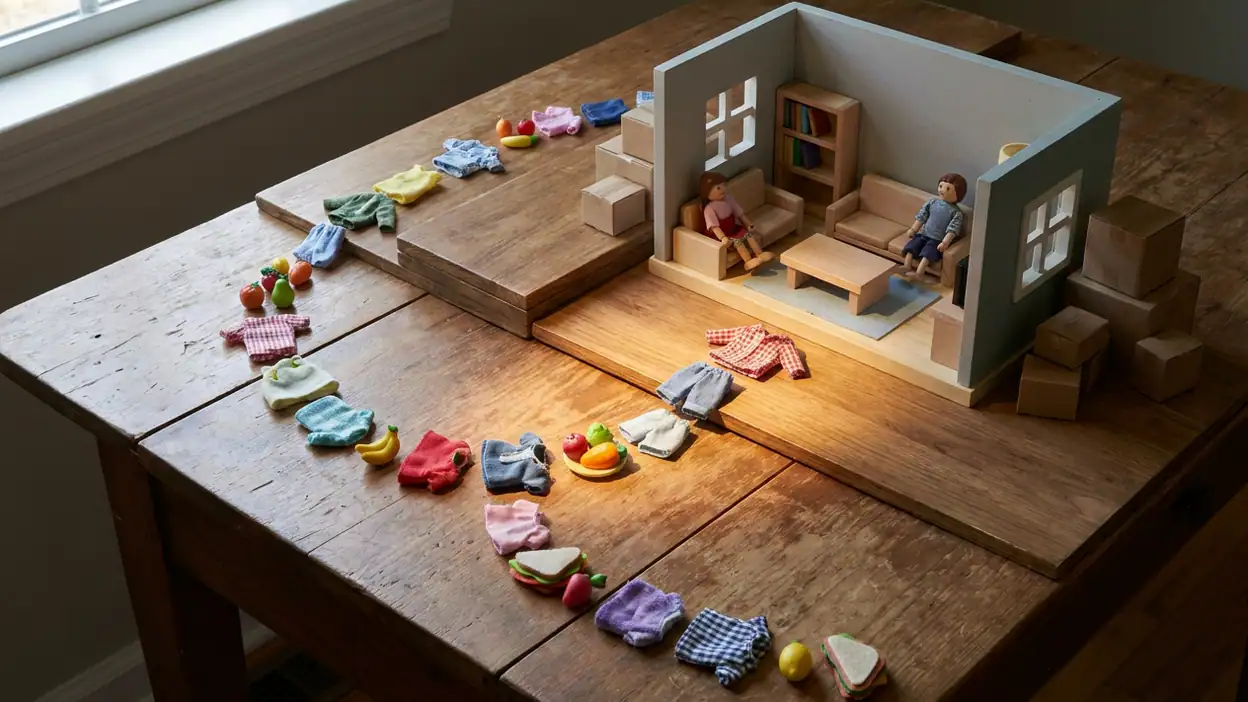
The hook is simple enough to explain to a child: create characters, dress them, move them through attractive locations, and invent what happens next. In practice, the appeal is closer to playing with a digital dollhouse. I can place a character at a table, change the room around them, add food or toys, and turn a few taps into a scene with an implied backstory. Nothing needs to be won for the scene to feel complete.

That makes the community hook unusually visual. Players do not need to explain a complicated strategy or prove mastery of a difficult level. A screenshot of a carefully arranged bedroom, a short role-play video, or a sequence showing a character's morning routine can communicate the idea immediately. The product's social currency is therefore not victory. It is recognizable imagination: a familiar situation given a personal twist.
Compared with Subway Princess Runner, which creates shareable moments through speed and score, Avatar World creates them through arrangement. Compared with Ludo Club, where social energy comes from direct competition, it favors performance without an opponent. That difference shapes everything that follows. Players are not primarily gathering to beat one another. They are gathering to see what other people imagined and to borrow techniques for making their own scenes more convincing.
The participation model
Avatar World has a low-pressure participation model. A player can spend five minutes changing an outfit, twenty minutes furnishing a room, or much longer building a sequence of pretend events across several locations. There is no single correct rhythm. The game accommodates quick visits and elaborate sessions, which is important for a product aimed at younger players and families with uneven attention spans.
The core loop is tactile and immediate. Choose a character, move them into a space, pick up an object, place it somewhere, and adjust the scene until it feels right. Then repeat the process with a new location or scenario. The loop lacks the escalating challenge of a traditional role-playing game, but it gains a different kind of replay value: every object can become part of several stories. A kitchen is a kitchen until it becomes a restaurant, a family breakfast, a science lab, or the setting for a disagreement between characters.
That openness also explains why the game travels well through creator communities. A player can watch someone else's scenario and reproduce its structure without copying every detail. A bedroom makeover becomes a template. A school-day story becomes a prompt. A themed outfit becomes a starting point. The game does not need a formal challenge system because its audience continually invents informal ones.
Still, participation is not equally visible everywhere. The app itself is largely a private or local creative space, while the broader community gathers through platforms such as short-video feeds, image boards, and video channels. Those spaces have their own recommendation systems, incentives, and moderation rules. Any claim about a unified Avatar World community should therefore be qualified: what exists is better understood as a network of overlapping audiences than as one central social club.
How newcomers enter
Newcomers enter through imitation. A child may see a room tour, a character makeover, or a short story online and recognize that the scene was made inside Avatar World. A parent may encounter the game through a child asking to recreate a video. An older player may arrive because the app appears to offer a calmer alternative to competitive games. In each case, the first lesson is not a tutorial screen. It is a visible example of what another player did.
This is a strong onboarding advantage. The game communicates possibility through finished scenes. A new player does not need to understand every item before beginning; they can choose one idea and work backward. The interface is approachable enough for experimentation, and mistakes are usually reversible. Moving an object to the wrong place does not cost a life or ruin a campaign. That forgiving structure gives beginners room to develop their own habits.
The weakness is that newcomers may also inherit the community's narrowest expectations. Popular videos often emphasize polished homes, fashionable outfits, large families, or highly scripted drama. A player who sees only that content may assume that creative success means reproducing a familiar look. The game is open-ended, but social feeds can make it feel surprisingly standardized.
Parents also enter differently from children. They may be evaluating the app as a play environment rather than seeking a community identity. They want to know what the child can do, whether purchases are prominent, and whether outside sharing is necessary for enjoyment. Since much of the visible ecosystem operates beyond the game, parental guidance matters more than it would in a completely self-contained offline toy.
Recurring rituals
The community's rituals are small, repeatable, and easy to recognize. Room tours are one of the clearest. Players walk through a home, apartment, classroom, shop, or other location while showing how objects have been arranged. The ritual rewards detail: a breakfast laid out on a table, clothes stored in a particular order, a pet given its own corner, or a character assigned a routine that hints at a larger story.
Character makeovers create another recurring format. Players change hair, clothing, accessories, and sometimes the social role implied by the outfit. The transformation is satisfying because the before-and-after contrast is immediate. It also gives viewers a simple prompt for participation: recreate the look, improve it, or build a character with an opposite personality.
Story episodes are more ambitious. They may involve school, friendship, family conflict, holidays, travel, or an invented mystery. The production value varies widely, but the format is familiar enough that even a basic sequence can be understood. Players often use repeated settings and characters, turning the game into a low-cost stage set for serial fiction.
There are also quieter rituals that rarely become headline content. Players reorganize a room after unlocking new items, revisit older characters, create seasonal scenes, or reset a location simply because the previous arrangement no longer feels right. These habits are important because they show how the game retains attention without demanding constant novelty. The reward is not only acquiring something new; it is seeing old pieces in a new arrangement.
Unlike Google Maps Go, whose usefulness is reinforced by repeated real-world tasks, Avatar World builds repetition through imaginative maintenance. The player returns not because a destination has changed, but because the fictional household has another day to live. That is a softer form of stickiness, and it depends on whether the player still feels ownership of the world.
What players and creators contribute
The most valuable contributions come from players who turn a flexible sandbox into a readable format. They establish characters with recognizable personalities, use locations consistently, and create visual cues that viewers can follow. A creator who places the same character in a sequence of carefully staged situations is doing more than decorating. They are teaching the audience how to read the game as a storytelling tool.
Other contributors focus on practical creativity. They share layout ideas, outfit combinations, room themes, and methods for using ordinary objects in unexpected ways. This kind of content expands the perceived inventory. A player may own the same set of items as everyone else, yet discover new possibilities by watching how another person combines them.
Creators also provide informal quality control. A well-made video demonstrates what is possible, while a confusing or repetitive one shows the limits of a particular format. Over time, recurring creators become guides to the ecosystem. Their audiences learn which updates are worth exploring, which locations support certain stories, and which visual conventions are currently popular.
That contribution is not fully supported by formal in-game tools. The app gives players material to work with, but it does not necessarily give them robust systems for publishing, collaborating, crediting, or discovering one another inside the same space. As a result, creators must rely on external recording and sharing tools. This keeps the app approachable, but it also means the community's most important labor happens outside the product's direct control.
There is a productive tension here. Because the game does not prescribe a strict creator economy, players can experiment without needing to optimize every action for rewards. At the same time, creators who want reach are subject to outside platform algorithms. The most inventive scene is not guaranteed to travel; the most dramatic or instantly legible one may perform better. Avatar World provides the stage, but other platforms decide much of the audience flow.
Social friction beneath the cheerful surface
The first source of friction is repetition. A community built around recognizable formats can become predictable. The same family roles, room styles, school plots, and makeover structures appear again and again because they are easy to understand and easy to reproduce. Familiarity helps newcomers enter, but it can flatten originality.
The second is uneven access. Some players have more content, more time, or more experience arranging scenes. Others may be working with a smaller selection of locations and items. In a purely private game, that difference is mostly personal. In a visible community, it can become a status marker. A polished scene may reflect patience and creativity, but it may also reflect access to more content or better recording tools.
There is friction around imitation as well. The community thrives when players borrow ideas, yet the line between inspiration and copying can be thin. A room layout, character concept, or story premise may circulate widely without clear credit. Because the game is built from shared assets, originality is often measured through arrangement and narrative rather than ownership of individual objects. That makes credit difficult to define and disputes difficult to settle.
Competition is present, but it is indirect. Players may compare outfits, homes, follower counts, or storytelling polish even when the game itself has no formal leaderboard. This can turn a relaxed role-playing toy into a performance space. The pressure is not to win a match; it is to make a scene that earns attention. For some players that pressure encourages craft. For others it may make free play feel like work.
Cooperation has a similar ambiguity. Players can exchange ideas and respond to prompts, but collaboration may happen through separate recordings or shared accounts rather than a built-in co-play system. The result is a community that feels cooperative in spirit while remaining largely individual in execution.
Moderation and safety unknowns
The app's friendly design should not be confused with a fully visible safety system. Much of the community activity associated with Avatar World happens on external platforms, where age policies, recommendation systems, comments, direct messages, advertising, and user reporting work differently. Without inspecting every current version, regional setting, and connected platform, it would be irresponsible to make sweeping claims about the complete safety picture.
What can be said more confidently is that the game's social risk is often displaced rather than removed. A child may enjoy the app privately, then encounter community content through a video platform or search result. The transition from controlled play to public media can introduce comments, creator pressure, commercial prompts, or material that the original game does not contain.
Parents should therefore treat sharing as a separate activity. The question is not only whether Avatar World itself provides a pleasant play space, but also where screenshots and videos are being watched, who can respond, and whether the child understands that a fictional scene can still reveal personal information through usernames, voices, backgrounds, or routines.
Moderation also affects the quality of the ecosystem. If external communities reward sensational stories, creators may push toward conflict or shock because those formats attract attention. If platforms remove content inconsistently, smaller creators may struggle to understand the rules. These are not necessarily failures of the game developer; they are structural limits of a community that depends on services outside the app. Still, they shape the experience players associate with the product.
The safest reading is cautious rather than alarmist. Avatar World can function as a private creative toy without requiring public participation. That is a meaningful strength. But once a player enters the broader creator ecosystem, supervision and platform awareness become part of the experience.
Where network value appears
The network value appears in the exchange of possibilities. One player's room becomes another player's prompt. One creator's storytelling rhythm teaches another creator how to stage a scene. A new update becomes more valuable when the community demonstrates several ways to use it. The network does not simply add an audience; it increases the number of meanings attached to the same objects and locations.
This is why the game can feel richer after watching community content, even when no new feature has been installed. The player returns with a different eye. A sofa is no longer just furniture; it can anchor a family scene, a waiting room, a classroom corner, or a set for an interview. The community expands the game's vocabulary through examples.
Network value also appears in discovery. Players learn which parts of the world they had ignored. A location that seems decorative in isolation may become central to a popular scenario. An ordinary accessory may become a recognizable character detail. The community acts as a distributed guidebook, although its recommendations are shaped by trends rather than neutral coverage.
There is a useful contrast with Baby Panda World-Learning Game. That title can build value through structured educational activities and repeated lessons, while Avatar World builds value through interpretation. Its community does not primarily explain what an object teaches. It demonstrates what an object can mean inside a story.
Yet the network remains fragile because it is not fully anchored in the game. If external platforms change their recommendation systems, restrict younger creators, or shift audience habits, the visible community may shrink even if the app itself remains unchanged. The product has cultural reach, but not complete ownership of the channels that carry that reach.
Can the ecosystem last?
Avatar World's ecosystem can last as long as three conditions hold. First, the game must continue to provide enough new material to refresh familiar routines. New locations, objects, outfits, and seasonal ideas give creators reasons to return and audiences reasons to look again. Content alone is not enough, but without some renewal the community's formats will harden into repetition.
Second, the product must preserve low-friction creativity. If arranging characters becomes cumbersome, if essential expression is locked behind too many barriers, or if updates destabilize existing routines, players may lose the sense that the world belongs to them. The game's greatest advantage is that a small idea can become a finished scene quickly. That speed should remain central.
Third, the ecosystem needs room for different kinds of participation. Not everyone wants to publish videos. Some players want to decorate privately, follow creators, recreate scenes with friends, or invent stories that never leave the device. A healthy community should not define value only through visibility. If public performance becomes the default measure of success, quieter players may disengage.
There is also a question of age and audience transition. A product associated with younger players may need to keep earning the interest of families while remaining flexible enough for older children and creative hobbyists. Its visual style is approachable, but long-term retention will depend on whether the storytelling tools continue to support more complex scenarios without losing simplicity.
The ecosystem is more durable than a trend built on one viral format because its foundation is a repeatable activity: arranging a world and giving it a story. That activity has staying power. Still, durability should not be confused with endless novelty. The community will last if it keeps finding fresh uses for familiar pieces, not merely if it receives a steady stream of new ones.
Community verdict
Avatar World is best understood as a private role-playing sandbox with a public creative afterlife. Its community does not depend on direct multiplayer interaction, formal competition, or a central chat system. Instead, it grows through imitation, room tours, character makeovers, serial stories, and the quiet exchange of ideas that happens whenever one player sees another player's arrangement and thinks, “I could try that.”
That model gives the game unusual warmth. It rewards attention rather than reflexes, and it lets players participate at their own scale. A child can make a single outfit; a dedicated creator can build a recurring cast and a miniature series. Both are using the same basic tools, but the surrounding community gives those tools social meaning.
The limitations are just as clear. The ecosystem is scattered across external platforms, where moderation and audience incentives vary. Informal competition can turn relaxed play into performance. Repetition can narrow the creative field, and the absence of strong built-in collaboration means that much of the community's labor remains disconnected from the app itself.
My verdict is favorable, with a careful qualification: Avatar World has a genuine community ecosystem, but it is an ecosystem of shared imagination rather than a tightly integrated social network. Its lasting value comes from how easily players turn ordinary digital objects into stories and how quickly those stories become prompts for someone else. For families, creators, and players who enjoy open-ended role-play, that is enough to make the game feel alive. Just remember that the safest and most satisfying version of the experience may still be the one where the community begins with inspiration, not exposure.